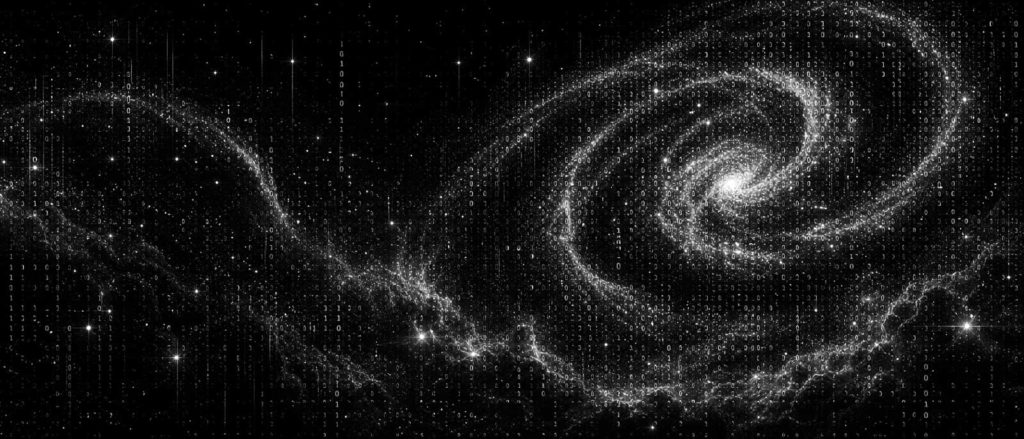
The origins of Binary Dust date back to 1993. I’d just finished my first degree in Astrophysics and was studying for a Masters in Computer-Music. By coincidence, the music dept at Glasgow University was directly opposite the Maths & Astronomy building: a short walk across the road into a different world.
At that time I made a very conscious decision to keep my ‘physics brain’ away from my ‘music brain’ as I had an in-built prejudice against them being allowed to occupy the same headspace, and a specific aversion to ‘sonification’ in my own practice (which is interesting to me, but in the same way as a graph, not in the same way as Rach No.2).
However, it was inevitable that they had to, and at various points along the way, others’ help to encourage (aka ‘insist’) that this happened.
Richard Karpen (now a Prof.) happened to be at Glasgow University on a Fulbright scholarship, and introduced me to some of the time-stretching (changing duration without changing pitch). In the same year, my friend Andy (now Prof. Andrew Newsam) did two things: spending hours helping me actually understand how FFTs and code worked, and then asking me to write the music for a production of Shakespeare’s The Tempest he was creating. This was all in addition to researching CSound, MaxMSP, granular synthesis, learning about Wishart’s On Sonic Art, Gabor’s Acoustical Quanta and the Theory of Hearing, the works of Xenakis and so many other things along the way.
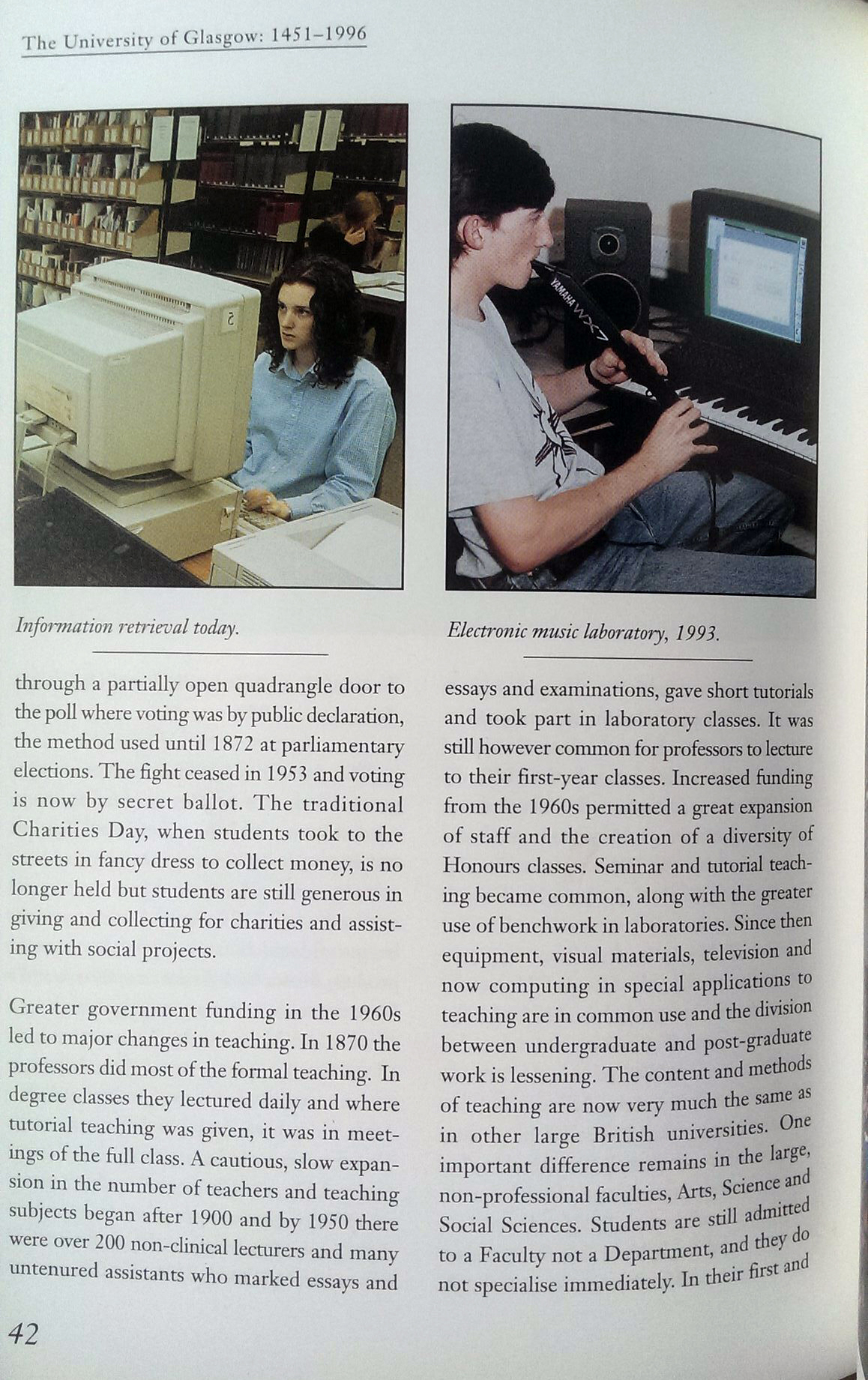
The first time I stumbled into the methods that would define this work it involved a room full of 10 NeXT computers all processing and playing sounds in real time, while I mixed them all in live, via a full rack of effects and analogue kit, onto DAT.
I was so excited with the outcome, I had to find a phone box (yes, that long ago!) to call Andy and tell him something along the lines of “I’ve just discovered the basis of all the music I will write in my life”—he was a little bewildered until he came over and hear it. ‘Tempest’ was subsequently selected by the ICMC for performance – I believe Richard may have been on the review panel and may have heard echoes of his algorithms.
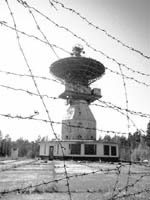
Fast forward ten years, including a stint at the Jodrell Bank radio telescope amongst many other things, and Honor Harger asked me to give a keynote lecture and performance at the re-establishment of a radio telescope in Latvia, RT32, as a joint science and arts facility. This resulted in the creation of the first really deliberate generation of a piece around a specific object, ds² – series 1, based on the discovery of the first double-pulsar system. You can listen to it now by using the player at the top left of this page.
In the mid-late 90s I was working on what would become the foundations of the streaming industry and music downloading (including distributing about 25% of the world’s music online). As I got deeper into what the implications of that might be – that the idea of a record shop would be replaced by a search box – something rebelled against the idea that not only had music transitioned from physical to non-physical instruments, but even the mode of playback was now dematerialising. And so, with a suitable nod to Kubrick’s 2001, and with the help of Alexei Blinov, I created a 19kg solid granite MP3 player, with an embedded radio transmitter, so that Binary Dust could be played by touching the stone, and heard via analogue radio transmission.
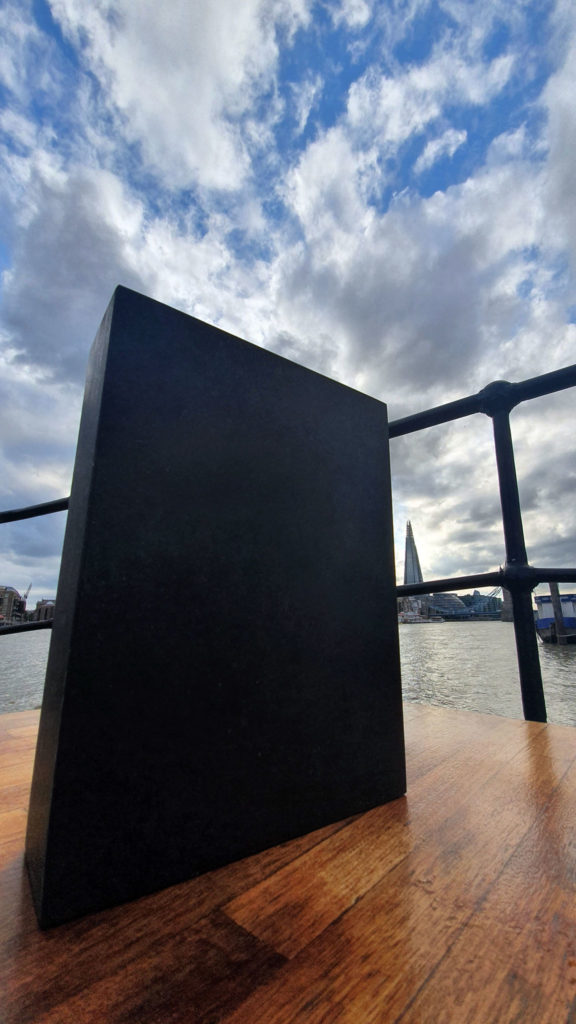
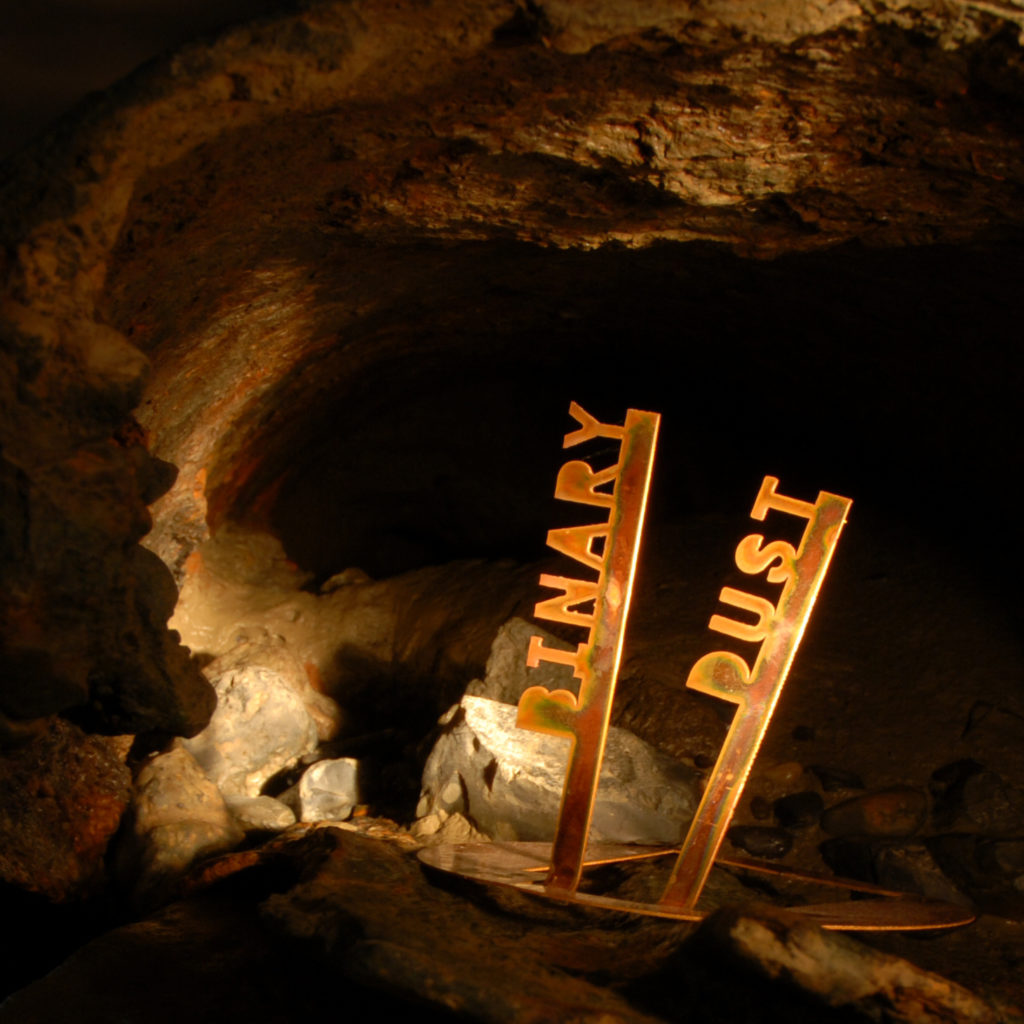
This interface with the physical has persisted, and when I was wanting to explore how to create album artwork, I was fortunate to collaborate with the creative genius that is Adrian Philpott. He created a beautiful rendering of the words in copper (and steel) and we spent many hours playing with photographing it in unusual settings. The image on the left is inside a broken drainpipe laying on the foreshore of the Thames near my boat – no photoshop! – and I used as the anchor image, for Tempest. Over many years, this copper object has travelled with me around the world, from Arran to New Zealand, Egypt to New Mexico (where, of course, it was situated on the Very Large Array – that image hasn’t yet been paired with a piece).
And so, for three decades (so far) I’ve been weaving astrophysics and music, trying to understand what they might actually have in common, not as metaphor or a literal translation, not just as inspiration, but as something more structural, architectural, looking and listening for patterns.
The questions that drive Binary Dust are long: is there a musical equivalent to the curvature of spacetime? While this might sound like a provocation, I mean it seriously: when you look across the history of music and the history of science, you find parallels and repeating patterns.
As our understanding of the universe has deepened, our language of music has changed with it: from the monophony of the 1400s, through polyphony and harmony, increasing in complexity through the romantic and operatic eras, into the reductionist mathematical compositions of Cage and Glass, and then forward again into the algorithmic and electronic forms we have today.
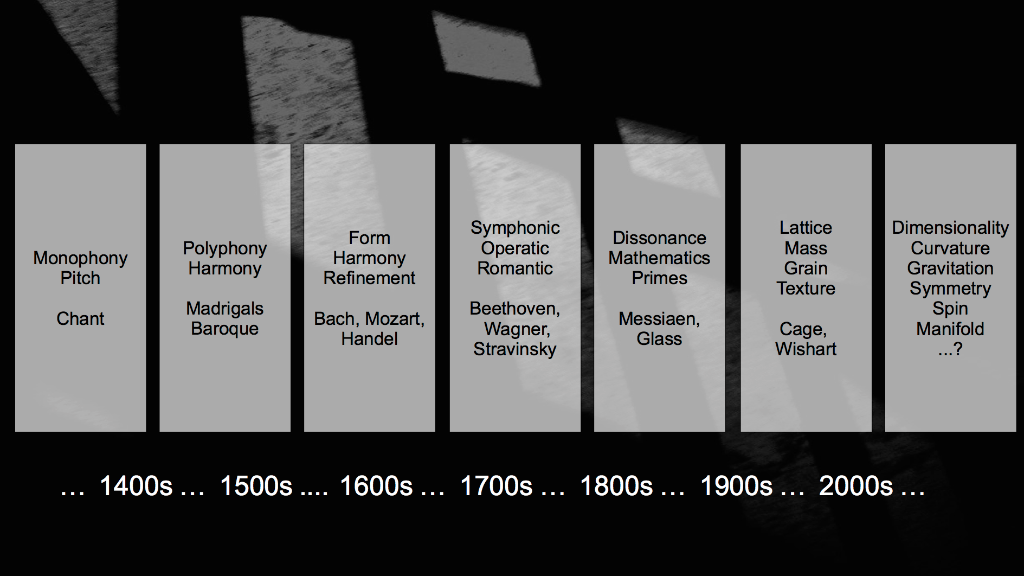
I don’t think these are coincidences: they parallel our cultural evolution, our scientific understanding, industrialisation, and evidence a shared cultural attempt to describe where we are and what we’re ‘inside of’. People have always pulled together whatever tools they can to make sense of the structure of things. There’s a reason Abbott’s Flatland and Gamow’s Mr Tompkins in Wonderland were influential books to read as a child, why Aronofsky’s film, Pi, instantly became one of my favourites when it was released in 1998, and why it made sense to be a Trustee of Longplayer to help think through how ‘a music’ might persist across the dimensions of time, space and culture.
One thing that’s changed is that we now have tools that simply didn’t exist before: electronic music created sounds with no causal link to any physical source and sounds that exist only in digital or recorded form, in a space you cannot enter because it physically doesn’t exist. This is a very ‘recent’ phenomenon in human history.
At the same time, astrophysics has given us the ability to measure gravitational waves, an understanding of the cosmic microwave background radiation, and observe pulsars spinning thousands of times a second.
Along the way, Andy and I have experimented with sonification, as stepping-stones. Sonifying galaxies so you can hear the structure of their spiral arms, by mapping their radio frequency emissions into sound. Or taking the Digitized Sky Survey as a source. Other tools and visualisations have helped better image what an n-dimensional space might look like, and these are all fantastic inputs into the process. Or using quasar spectra from “The Next Generation Atlas of Quasar Spectral Energy Distributions from Radio to X-rays”.

We’ve started the process of imagining Einstein’s theories of General Relativity as a ‘music of the hypersphere’, and how a Soniverse might exist as its own construct.
Binary Dust started out as the name of my ‘album’ but it’s now the umbrella term. It is a long-term, highly longitudinal work, and is my attempt to work inside these spaces.
We’ve been building a framework, Acoustic Cosmology, in which the mathematical structures of cosmology and quantum mechanics become compositional tools: again not as ‘analogy’ or ‘sonification’, but as derived from and inspired by actual rules for how sound behaves.
Its fundamental particle is the sonon (= one wavelength) and is the sonic equivalent of a photon. Sonons can cluster through temporal gravity, where wave-time can curve, and can be processed with ‘physical’ constraints (as defined by mathematics, not by anything in ‘this’ reality). The listener, like the observer in quantum mechanics, is the thing that collapses the uncertainty into something real, and silence has a shape determined by the gravitational influence of the sonons surrounding it.
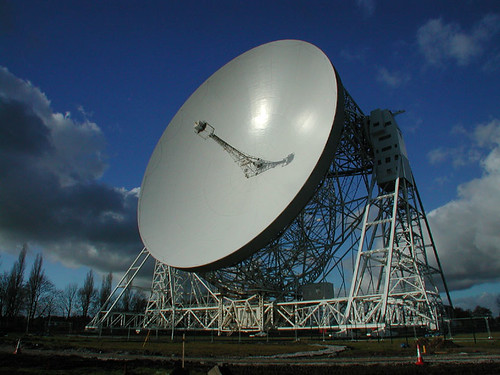
After years away from the astronomical research field, some old colleagues were more than a little surprised (as was I) when some of this was presented at the Royal Astronomical Society National Astronomy Meeting, and White Devil was used in the 50th anniversary celebrations at Jodrell Bank.
White Devil was originally commissioned by the wonderful Zoe Philpott (nee: Klinger) for her production of Webster’s play at La Belle Angel, Edinburgh in 1994. The play refers to a devil disguised in white, something radiant that conceals darkness and revelations through indirect means, which seemed wonderfully apt for Jodrell some 13 years later.
Binary Dust creations have been, very gradually, incrementally, performed and presented across five continents from New Mexico to Antarctica, from Hong Kong to Latvia, over 30 years so far.
I’m curious what language we’ll be using to describe all of this in the years to come.
It is enticing to be drawn back to The Tempest, where imposing order on a space with its own prior logic was at play. Must we break the staff and drown the books to dissolve our instruments back into the elements? Should we release of stochastic control back to the distribution? Do the grains widen until they loses their frequency? Do they have a quantum state? There’s something in all these gestures that links us back to entropy: a soniverse expanding until it decays back to noise; crystallisation returning to randomness; a wave-time curving back toward the singularity.
For me, this is a project without end and, by design and, because life also happens, will take time, space and energy. More soon/later… 😉
With huge additional thanks to:
Binary Dust artefact design & creative: Adrian Philpott
Piano: Peter Clive (and Cosmology)
Player electronics: Alexei Blinov (RIP)
Ideas: Ulyana Gumeniuk (Artist), Andrew Conway (Astrophysics) and Jaako Mattila (Artist)